7.10 How Can Jesus Be Both God and Man? The Concept of Incarnation
Introduction #
The question of how Jesus can be both fully human and possess a divine nature lies at the heart of Christianity. For many, this idea seems contradictory: how could one and the same person possess divine attributes (eternity, omniscience, omnipotence) while also experiencing human limitations (fatigue, ignorance, suffering, death)?
Several philosophers and theologians have proposed different approaches to try to resolve this tension. The main theories are presented and discussed in a video in french (Philo addict. INCARNATION - Dieu peut-il devenir un homme ?)1. I will summarize its content below.
1. The kenotic theory (or kenosis) #
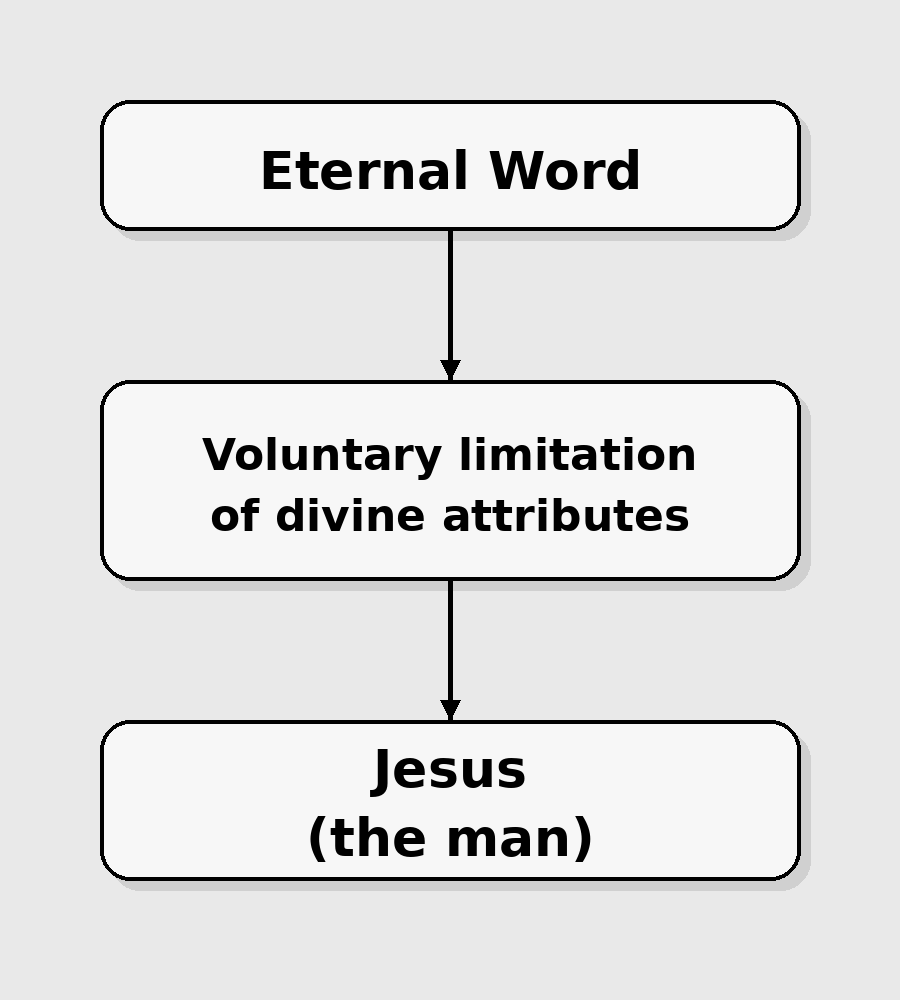
The first approach is called the kenotic theory. It is based on the idea that God the Son voluntarily emptied himself (kenosis in Greek) of certain divine attributes, such as omniscience or omnipotence, in order to become fully human.
This idea is often connected to a passage in the letter to the Philippians:
Philippians 2:6–7
“Who, though he was in the form of God, did not count equality with God a thing to be grasped, but emptied himself (ekenōsen in Greek), taking the form of a servant, being born in the likeness of men.”
This verse is the origin of the word kenosis and serves as the biblical foundation for this approach. According to this interpretation, Jesus is not at once omniscient and ignorant; rather, he would have voluntarily set aside his omniscience in order to live the human experience.
However, this theory runs into serious difficulties. It makes God a contingent and changeable being, whereas the classical view describes him as immutable and necessary. Moreover, if God can give up his essential attributes, such as eternity, omnipotence, or immateriality, then those attributes are no longer constitutive of his divine nature. This calls into question the very meaning of what it is to be God. For this reason, the kenotic theory is considered inconsistent with the traditional conception of God and does not provide a satisfactory explanation of the Incarnation.
2. The distinction between the two natures #
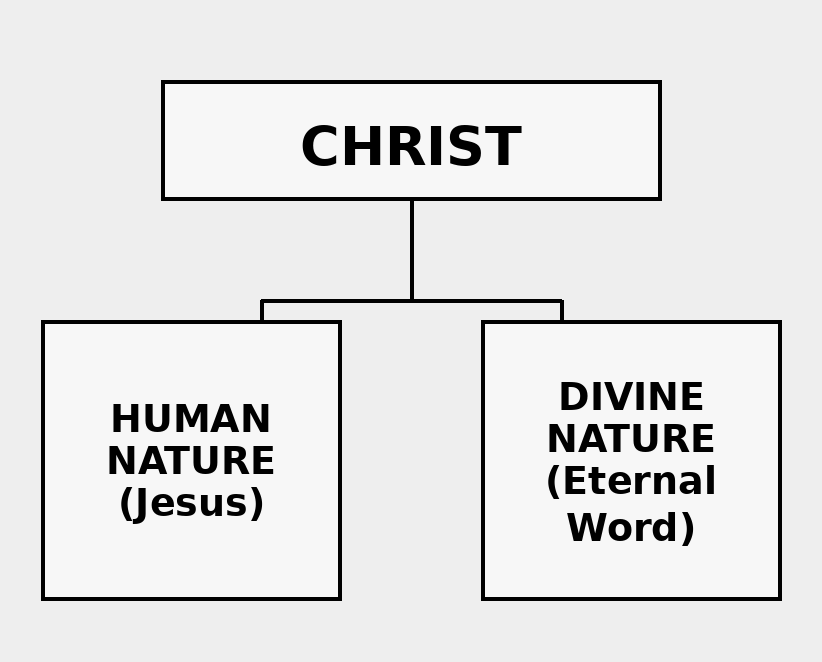
Another path, more in line with Christian tradition, is to distinguish clearly between Christ’s two natures. Jesus is one person, but he possesses two distinct natures: a divine nature, eternal and omniscient, and a human nature, temporal and limited. Thus, the divine attributes belong only to the divine nature, while the human limitations concern only the human nature.
This approach corresponds to the official teaching of the Church. As early as the Council of Chalcedon (451)2, Christians affirmed that Christ must be:
“acknowledged in two natures, without confusion, without change, without division, without separation; the distinction of natures being in no way removed because of the union, but rather the properties of each being preserved and concurring in one person and one hypostasis.”
The Catechism of the Catholic Church3 restates this doctrine as follows:
“The Church thus confesses that Jesus is inseparably true God and true man. He is truly the Son of God who became man, our brother, and that without ceasing to be God, our Lord…”
Thus, according to classical Christian faith, Jesus is fully God and fully man, without confusion of natures, yet united in one person.
Even so, this explanation remains abstract. It does not fully answer the question of how one and the same person can truly live out two seemingly contradictory psychologies. For example, God is omniscient and timeless, whereas Jesus had to learn and lived in time. The distinction of natures avoids contradiction, but it does not really explain how these two experiences come together in one person.
3. The Composite Action approach (Rogers) #
The Composite Action approach, developed by the philosopher Katherin A. Rogers, seeks to solve the ontological problem of the Incarnation: how one person can exist and act in two different orders of being. To shed light on this mystery, Rogers uses two analogies: that of a puppet, which she considers inadequate, and that of a video game, which she finds much more relevant. In this perspective, the Incarnation is understood as a state of action: God acting in humanity.
3.1. The puppet analogy #
Some have tried to explain the Incarnation by comparing God to a puppeteer manipulating a puppet.
- Jim (the puppeteer) would represent the eternal Word.
- The puppet (M) would represent the humanity of Jesus.
- Jim + the puppet in action (JM) would correspond to the incarnate Christ.
But this image has significant limitations:
- Same order of existence: the puppeteer and the puppet both belong to the same three-dimensional world. This does not do justice to the radical difference between God and man.
- Independence: the puppet exists on its own, even when it is not being manipulated. This could suggest that the humanity of Jesus had an independent existence, which would contradict Chalcedon.
- Instrumentality: the puppet is merely an external tool. This image risks reducing Christ’s humanity to an empty shell, close to the heresy of Apollinarianism.
3.2. The video game analogy (Composite Action) #
The philosopher Katherin A. Rogers proposes a more fitting image in her article The Incarnation as Action Composite4: that of a video game player and his avatar.
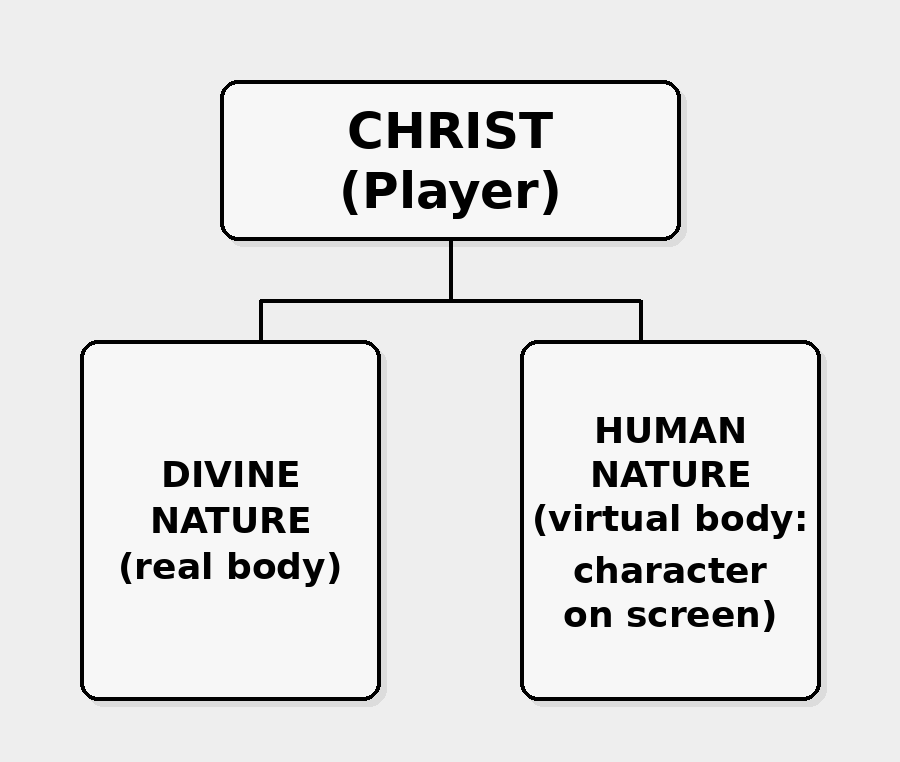
- Nick (the real player) represents the eternal Word (W).
- The character on the screen (NC) corresponds to the human nature of Jesus (H).
- Nick playing his character (NP) corresponds to the incarnate Christ (WI).
This analogy highlights several essential points:
- Two orders of being: Nick exists fully in the real world; his character exists in a “thinner,” created, dependent world. Likewise, God is absolute Being, and the humanity of Jesus exists in a lower order of being.
- Radical dependence: the avatar exists only because Nick is playing it. Likewise, the humanity of Jesus exists only as assumed by the Word.
- Real unity: there are not two persons, but one. It is always Nick who acts, even through his character. In the same way, there is only one person in Jesus Christ.
- An “action composite”: the Incarnation is a state of action, not a material fusion. Just as “Nick playing” exists only so long as he is acting, “the incarnate Word” refers to God acting in humanity.
- Expression and revelation: the other characters in the game see only the avatar, but it is Nick who acts through it. In the same way, Jesus’ contemporaries saw his humanity, but it was truly God who was manifesting himself in him.
This analogy is more faithful than the puppet analogy because:
- it respects the difference in level of being between God and man,
- it expresses the total dependence of the humanity on the Word,
- it preserves personal unity: one agent, two modes of existence.
3.3 Clarification on consciousness #
In both analogies, there is only one consciousness. In the puppet image, only the puppeteer’s consciousness exists; the puppet has none. In the video game image, only the player’s consciousness is real, but it is manifested in two ways: in the real world and in the virtual world. Rogers therefore wants to show that one person can act in two orders of existence without needing to posit two separate consciousnesses.
The problem with this approach is explaining how one person can have two distinct modes of thought: a divine mode of thought (God does not think successively, he is omniscient, he learns nothing…) and a human mode of thought (limited, having to learn…).
4. The two-minds theory (Morris, Craig) #
The two-minds theory, developed by Thomas Morris in The Logic of God Incarnate5, seeks to solve the psychological problem of the Incarnation: how can one and the same person, at the same time, know everything as God and yet be ignorant of certain things as man?
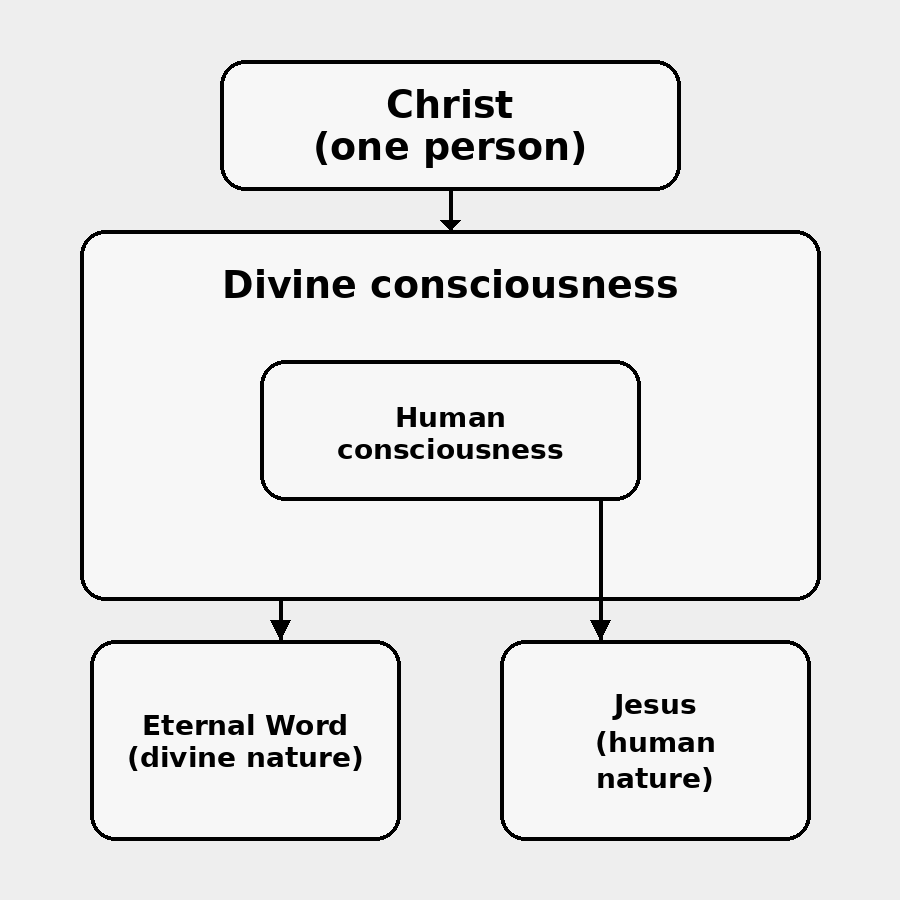
Unlike Rogers’s approach, which assumes only one consciousness acting in two different orders of being, the two-minds theory holds that in Christ there are two distinct consciousnesses:
- a divine consciousness, omniscient, timeless, and infinite;
- a human consciousness, limited, temporal, and progressive.
These two consciousnesses coexist without being confused, but they belong to one and the same person (Christ).
👉 One could say that Jesus “knew everything” in his divine consciousness, but that this knowledge was not always accessible to his human consciousness.
To make this idea more intuitive, Morris proposes an analogy with the experience of dreaming:
- When we dream, there is a dream consciousness (that of ourselves within the dream, limited by the laws of the dream).
- But there is also the waking consciousness (the one we have outside the dream), which transcends the universe of the dream.
These two consciousnesses are distinct, yet they belong to one and the same person.
In the same way, Jesus possessed:
- a human consciousness, lived out in time and subject to the limits of the human condition,
- and a divine consciousness, eternal and unlimited.
The key to this theory is that the two consciousnesses are not separated like two different individuals. They are united in one person, sharing one will and one center of identity. The divine consciousness “contains” the human consciousness, just as waking consciousness contains the dream, but without abolishing it.
👉 Thus, Jesus could truly learn and ask questions in his humanity while still remaining, in his divinity, omniscient and timeless.
Conclusion #
These different approaches show that the Incarnation can be thought of coherently, even if each one has its own difficulties.
- The kenotic theory, though attractive, calls into question God’s immutability.
- The distinction between the two natures is the classical doctrine affirmed at Chalcedon, but it remains abstract.
- The Composite Action approach (Rogers) addresses the ontological problem: one divine person acting in two orders of being, illustrated by the video game analogy. It assumes one single consciousness, acting in two ways.
- The two-minds theory (Morris, Craig) addresses the psychological problem: one person with two real consciousnesses, one divine and one human.
These last two approaches do not oppose one another, but can be seen as complementary: Rogers sheds light on the level of Being, Morris on the level of consciousness.
In the end, the Incarnation remains a mystery, but it is not a logical impossibility. It can be understood coherently how Jesus can be both God and man.
The eternal Word became incarnate in Jesus. Christ therefore has both a divine nature (the eternal Word) and a human nature (Jesus). One person, but two natures.
Further reading #
Philo addict. INCARNATION - Dieu peut-il devenir un homme ? https://www.youtube.com/watch?v=v511owU39sA&list=LL&index=37&t=203s ↩︎
Concile de Chalcédoine (451), Définition de foi. ↩︎
Catéchisme de l’Église catholique, §§ 464–469. PDF disponible ici ↩︎
Rogers, Katherin A. (2013). The Incarnation as Action Composite. Faith and Philosophy, 30(3), 251–269. PDF disponible ici. ↩︎
Morris, Thomas V. (1986). The Logic of God Incarnate. Cornell University Press. ↩︎