3.1 The Big Bang Theory
At the beginning of the 20th century, our view of the universe underwent a profound transformation, shifting from a cosmos considered static and eternal to one that is dynamic and expanding. Einstein’s theory of general relativity revolutionized our understanding, while the work of Friedmann and Lemaître—confirmed by Hubble’s observations in the 1920s—established that the universe is continuously expanding.
Tracing this expansion backward in time implies that the universe was once infinitely dense and hot, with all matter and energy concentrated in an extremely small volume—giving rise to the Big Bang theory. Contrary to a common misconception, the Big Bang does not describe an explosion within preexisting space, but rather the expansion of space itself from an extraordinary initial state.
In this chapter, we will examine:
- how this theory was developed,
- what observations support it,
- what assumptions it involves,
- and which questions remain open today.
The Origins of the Big Bang Theory #
Albert Einstein and General Relativity (1915)
- In 1915, Albert Einstein published the theory of general relativity, a new way of describing gravity—not as a force, but as the curvature of spacetime caused by mass and energy. His equations suggested that the universe is dynamic: it must either expand or contract.
- Uncomfortable with this conclusion (since he believed the universe to be static), Einstein introduced the “cosmological constant” in 1917, a mathematical term intended to prevent the universe from collapsing or expanding. He later referred to it as his “greatest blunder,” although a form of the cosmological constant (dark energy) has now been reintroduced to explain the accelerated expansion of the universe 1.
Alexander Friedmann and Georges Lemaître and the idea of an expanding universe (1920s)
- 1922–1924: Russian physicist Alexander Friedmann published solutions to Einstein’s equations showing that the universe could be expanding or contracting 2. He demonstrated mathematically that a “static” universe is not the only possibility.
- 1927: Belgian priest and physicist Georges Lemaître built on these solutions and connected them to observations. He proposed that the universe is expanding and that it began from an extremely dense and hot state, which he later called the “primeval atom.” Lemaître established the distance–redshift relation and became the first cosmologist to estimate the rate of expansion of the universe 3.
- Important nuance: Lemaître relied on galaxy redshifts and distance estimates to establish his distance–redshift relation, rather than on a “radiation rate” 4. This law is now officially called the Hubble–Lemaître law (since 2018), in recognition of Lemaître’s fundamental contribution.
Their theoretical work forms the conceptual foundation of the Big Bang model.
Observational Evidence for the Big Bang #
Several independent observations confirm this picture of a universe that was once much hotter and denser, and has been expanding for billions of years.
- Expansion of the universe: the Hubble–Lemaître law shows that the universe is expanding.
- In 1929, Edwin Hubble observed that the farther away a galaxy is, the more its light is redshifted (relation v = H₀ d). He combined distance measurements (Cepheids, then other indicators) with velocity measurements (spectral lines) 5.
- What does this redshift mean? Wavelengths are stretched because space itself is expanding. This is not simply a classical “Doppler effect” in a static space. This law is now known as the Hubble–Lemaître law, recognizing Lemaître’s contribution 6.
- Relic radiation: the cosmic microwave background (CMB), a thermal remnant of the early universe 7.
- Prediction (1948): Ralph Alpher and Robert Herman predicted the existence of radiation at about 5 kelvins, released when the universe became transparent (~380,000 years after the beginning). This prediction emerged from the detailed development of the hot Big Bang model, although it was often attributed to George Gamow in the scientific literature 8.
- Discovery (1965): Arno Penzias and Robert Wilson detected an isotropic microwave signal at ≈ 2.7 K, confirming the prediction. This discovery established the Big Bang model.
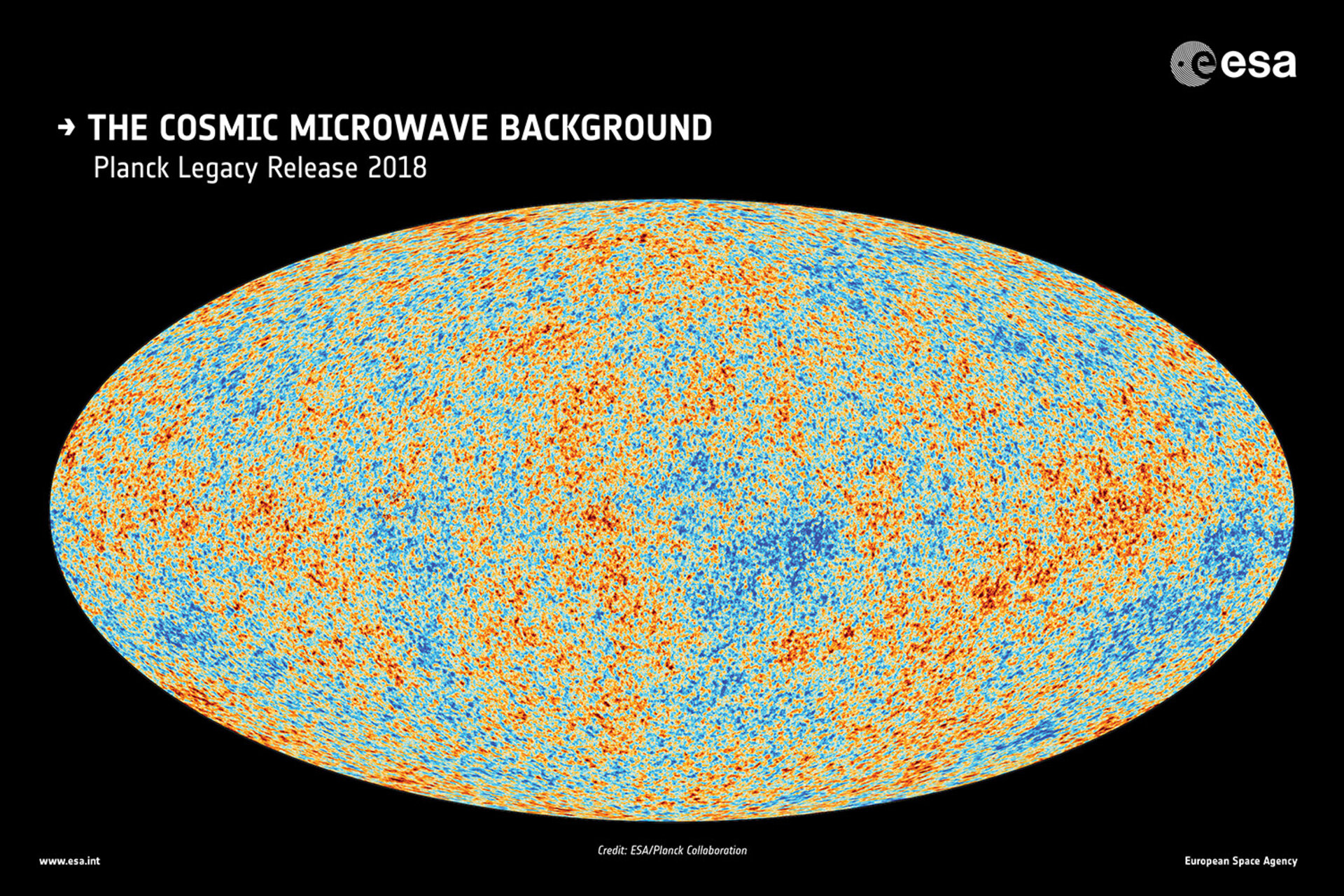
- Precise measurements: the COBE satellite (1989–1992) measured an almost perfect blackbody spectrum (2.725 K) and tiny anisotropies (~10⁻⁵). WMAP and then Planck mapped the “curve” of these fluctuations (acoustic peaks), allowing precise determination of the age of the universe, its matter content, its curvature, etc.
- Why this matters: these tiny temperature variations are the seeds that, under gravity, will form galaxies and galaxy clusters.
Abundance of light elements: the chemical “recipe” of the early universe
- When? From ~1 second to ~3 minutes after the Big Bang, at temperatures above 10⁹ K. Protons and neutrons fuse to produce mostly helium-4 (≈ 24–25% of the mass), along with small amounts of deuterium, helium-3, and lithium-7.
- What we observe: In very weakly processed environments—near-primordial gas clouds and old, metal-poor stars—the measured abundances match remarkably well with predictions from primordial nucleosynthesis. A slight “lithium tension” remains: the observed amount of Li-7 is lower than predicted.
- Why this matters: This precise mixture can only be produced in a universe that is extremely hot and dense for a very short time. An eternal, steady-state universe would have allowed much more time to transform hydrogen; these proportions would not be observed.
Cosmic Inflation: A Key Hypothesis (but still to be tested) #
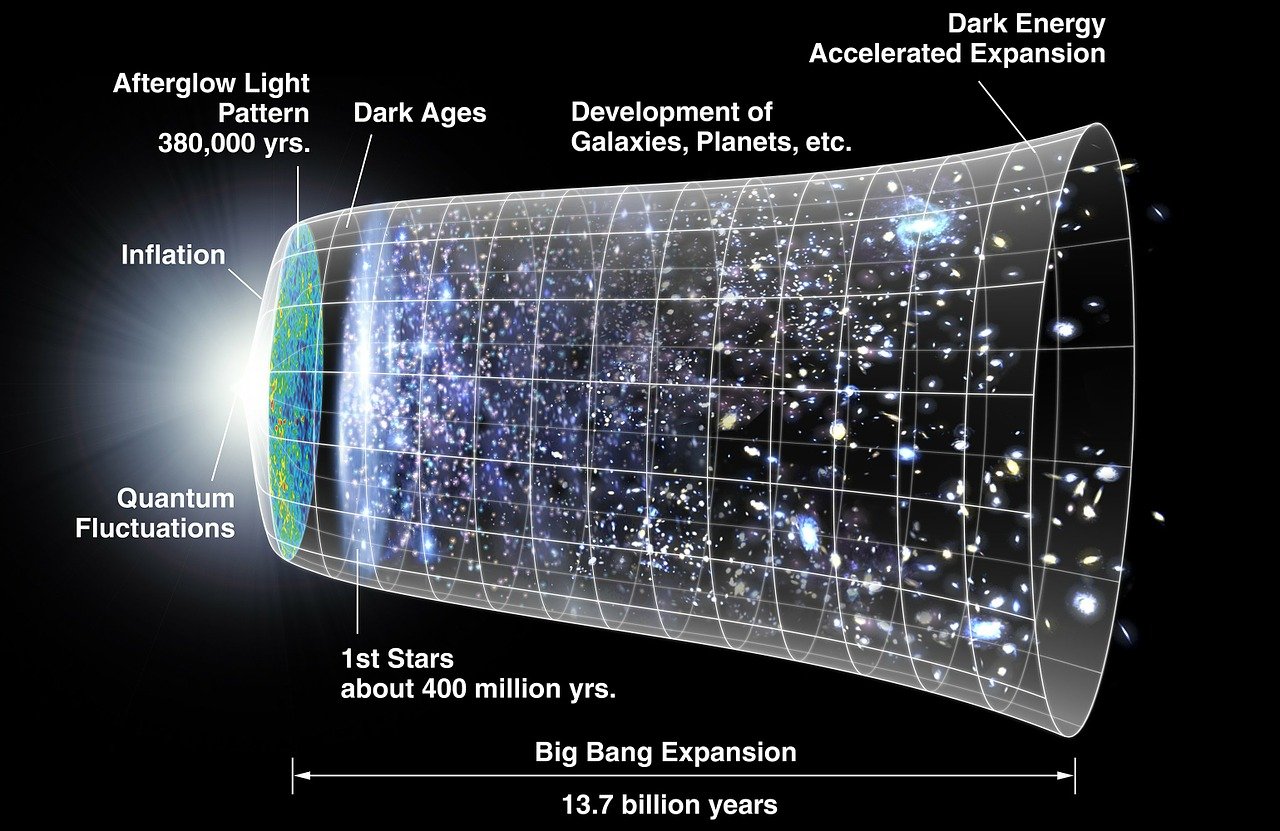
In the 1980s, physicist Alan Guth introduced the concept of cosmic inflation. This refers to a phase of exponential expansion, occurring around 10⁻³⁶ to 10⁻³² seconds after the Big Bang, during which the universe’s volume increased by an enormous factor in a fraction of a second.
Why propose such an idea? Because the classical Big Bang model alone could not explain several puzzles 9:
- The horizon problem: Without inflation, different regions of the observable universe would never have been in causal contact. Yet they display identical properties, such as uniform temperature. Inflation explains this homogeneity: before the phase of extreme expansion, these regions were close enough to exchange information and energy 10.
- The flatness problem: Observations show that the universe is nearly flat, meaning that space is neither positively curved (closed) nor negatively curved (open). Without inflation, this would require extremely fine-tuned initial conditions. Inflation acts as a flattening mechanism.
- The monopole problem: Grand unified theories predict magnetic monopoles formed after the hot Big Bang. Without inflation, their density today should be comparable to that of protons. Yet none have been observed. Inflation dilutes them to undetectable levels.
- The origin of structure: Inflation also explains why the universe is not perfectly uniform. Tiny quantum fluctuations were stretched to cosmic scales, becoming the seeds of galaxies and clusters.
Although widely accepted, inflation remains an active area of research with ongoing debates and alternative proposals.
The ΛCDM Model (Cold Dark Matter and Dark Energy (Λ)) #
Since the 1970s, it has become clear that the “hot and dense” Big Bang model alone is not sufficient to account for all cosmological observations. Certain measurements—whether involving the dynamics of galaxies, the formation of large-scale structures, or the evolution of cosmic expansion—reveal significant discrepancies with the predictions of a universe composed only of ordinary matter and radiation.
To account for these anomalies, cosmologists have been led to introduce two major new components: dark matter and dark energy. Together, they now form the core of the standard cosmological model, known as ΛCDM.
The following two sections trace this development: first, the observations that led to the introduction of these hypotheses, then the more recent discoveries that test their validity and reveal their limits.
Observations behind the ΛCDM model
In galaxies, stars located at the outskirts rotate far too rapidly given the amount of visible luminous matter alone. Likewise, in galaxy clusters, the mass inferred from the motions of galaxies, the hot gas detectable in X-rays, and gravitational lensing effects far exceeds the visible mass. On cosmological scales, precise maps of the cosmic microwave background reveal that a substantial additional matter component is needed to explain the formation of the large-scale structures we observe. The most parsimonious solution is to postulate the existence of additional matter that is invisible and effectively stable on the relevant timescales: cold dark matter. By nature, it emits little or no light, interacts primarily through gravity, and provides the gravitational scaffolding around which cosmic filaments, galaxies, and clusters form.
A conceptual revolution occurred in 1998, with a spectacular surprise: observations of distant Type Ia supernovae revealed that they appear systematically fainter than expected 11, a direct indication that the expansion of the universe is accelerating rather than slowing down. However, high-precision measurements of the cosmic microwave background indicate that the universe is geometrically almost flat 12. To reconcile this spatial flatness with accelerated expansion, it becomes necessary to introduce a new component exerting negative pressure and driving space to expand at an accelerated rate: dark energy, whose simplest description remains the cosmological constant Λ. By combining data from Type Ia supernovae, baryon acoustic oscillations (BAO), and the CMB, cosmologists arrive at a coherent picture of the universe: it is made up of about 5% baryons, roughly 25% cold dark matter, and approximately 70% dark energy—thus yielding the ΛCDM model, which has become the standard paradigm.
Are there substantial criticisms of these hypotheses? Certainly. Several competing proposals remain in the scientific literature. To avoid the need for dark matter, some researchers propose modifying the laws of gravity on large scales, notably through MOND (Modified Newtonian Dynamics) and extensions such as TeVeS. These alternative models reproduce certain galaxy rotation curves remarkably well, but they face crucial difficulties when confronted with other observational tests: the dynamics of galaxy clusters and maps of the CMB remain problematic. As for dark energy, other theories propose modifying gravity on cosmological scales—for example through f(R) theories or “back-reaction” scenarios—or allowing dark energy to vary over cosmic time. Although these approaches continue to be actively explored by the community, none has yet surpassed the simplicity and explanatory power of the classical ΛCDM model when the full body of observational data is considered together.
Nevertheless, notable observational tensions remain unresolved—mainly regarding the present value of the expansion rate H₀ (the Hubble tension) and the amplitude of the growth of cosmic structure (the σ₈/S₈ parameters). These tensions keep the major questions of cosmology open and motivate ever more stringent tests of the ΛCDM model. For the moment, however, cold dark matter and dark energy remain the two most effective and best-supported ingredients for accounting simultaneously and coherently for the internal dynamics of gravitational systems, the spatial geometry of the universe, and its expansion history from the Big Bang to the present day.
The ΛCDM model under the test of precision cosmology
After the ΛCDM framework was established, cosmology entered an era of high-precision measurements. Maps of the cosmic microwave background, first from WMAP and then especially from Planck, refined the key parameters (age, matter and energy content, nearly zero curvature) and confirmed the model’s overall consistency 13 14. Ground-based experiments such as ACT and SPT extended this work to smaller angular scales, providing independent checks and complementary constraints on cosmological parameters.
At the same time, large galaxy surveys revealed the imprint of baryon acoustic oscillations (BAO), a true standard ruler for reconstructing the history of cosmic expansion 15. Combined with weak gravitational lensing (KiDS, DES, HSC), these 3D maps have traced the growth of structure, tested gravity on large scales, and reinforced the picture of a universe structured by cold dark matter. More recently, the James Webb Space Telescope has revealed very early galaxies that are sometimes more massive or more luminous than expected, requiring refinements in models of star formation and galaxy assembly without overturning the basic framework of the standard model—these discoveries likely reflect the unexpected efficiency of certain star-formation processes rather than an invalidation of ΛCDM.
These advances do not eliminate all questions. The present value of the expansion rate differs depending on whether it is measured locally (Cepheids + supernovae, masers, strong lenses) or inferred from the CMB within ΛCDM; likewise, some indicators of structure growth suggest a mild tension. These discrepancies may result from systematic effects that are still poorly constrained, or they may point to new physics. Upcoming datasets—DESI, whose first high-precision measurements are already available 15, together with the forthcoming observations from Euclid and the Rubin Observatory—should clarify the extent of these tensions and, depending on the verdict, either strengthen the model or guide its evolution.
What now? #
The current cosmological model is not a fixed block: it is built from the available data, predicts quantifiable phenomena, and is then tested by new observations. When results do not fit, the model is revised. This cycle—observe → model → predict → test → revise—lies at the heart of progress in cosmology.
- Observe → Model. The first measurements of expansion led to the idea of an evolving universe; the physics of the primordial plasma suggested a hot, dense initial state.
- Model → Predict. Before 1965, a relic microwave background was predicted; it would later be detected by Penzias and Wilson. In the 1980s, inflation was introduced to solve the horizon and flatness problems: it predicts fluctuations that are nearly scale-invariant, adiabatic, and (almost) Gaussian, later confirmed by WMAP and Planck.
In 1998, Type Ia supernovae revealed cosmic acceleration: Λ (dark energy) was added; BAO, the CMB, and lensing all converged toward the same set of parameters. - Test → Revise. Today, tensions (H₀, σ₈/S₈) and surprises (very early galaxies seen by JWST) are pushing cosmologists either to refine the astrophysics and the analyses, or to extend the standard framework if necessary. Knowledge evolves: the model is adjusted in light of the best available data.
Key point: ΛCDM is a predictive tool that has passed many tests (expansion, CMB, BAO, light elements, structures), but it remains revisable. It is precisely because it makes precise predictions that it can be confirmed… or shown to be incomplete*—and therefore improved.
Every model rests on assumptions. To determine how far ΛCDM remains valid and where it may need adjustment, those assumptions must be made explicit and tested.
Underlying assumptions
Jean-Philippe Uzan, in Pour la Science no. 52116, examined the assumptions used by cosmologists to construct the Big Bang model. Indeed, every model, including the Big Bang model, rests on a set of assumptions that must be constantly questioned. As measurements become increasingly precise, are these assumptions—and therefore the model itself—still adequate for interpreting the observations? Should some of them be abandoned or modified?
Let us recall that every model is a working tool, a temporary consensus, necessarily limited and open to revision.
With some distance, four major assumptions can be identified, which we may label H1, H2, H3, and H4:
- H1: Gravitation is accurately described by the theory of general relativity.
- This implies that the universe is mathematically represented by a spacetime whose geometry is determined by Einstein’s equations.
- H2: Matter and its non-gravitational interactions (electromagnetic, strong nuclear, and weak nuclear) are described by the standard model of particle physics, which rests on quantum physics.
- H3: The universe is homogeneous and isotropic on large scales.
- According to this principle, we do not occupy a special place in the cosmos (the Copernican principle), and the universe we observe is therefore representative of the universe as a whole.
- H3 defines the local geometry of the universe.
- Mathematically, H3 implies that the spatial distribution of matter is homogeneous, that the expansion of space is the same in all directions and at every point, though it may change over time.
- H4: The universe has no complex large-scale structure.
- There is no “exotic” structure or major large-scale inhomogeneity/anisotropy beyond those already observed.
These assumptions are not absolute truths: they must be continually tested in light of new observations. Like any scientific model, the Big Bang model is expected to evolve. For now, it remains the most coherent and predictive theoretical framework for explaining the universe as we observe it, even though it exhibits certain limitations and internal tensions (such as those related to the Hubble constant or the nature of dark energy).
Conclusions #
The Big Bang model is today the strongest and most coherent framework for describing the history of the universe.
It rests on several converging and independent observations:
- the expansion of the universe,
- relic radiation,
- the abundance of light elements,
- and the formation of large-scale structures.
Complementary models—such as inflation, dark matter, and dark energy—make it possible to refine this understanding and to account for the observed data with great precision.
However, it is essential to distinguish between what the Big Bang describes… and what it does not describe.
- It describes the evolution of the universe from an extremely hot and dense state.
- But it does not, by itself, answer the question of the ultimate origin.
Several questions remain open:
- is this an absolute beginning or a limit of our models?
- what would a “before” the Big Bang mean?
- are the current laws of physics still valid under such extreme conditions?
Thus, the Big Bang marks above all a boundary of our current understanding.
Does the expansion of the universe necessarily imply an absolute beginning? That is the question we will explore in the next chapter.
Further Reading #
C. O’Raifeartaigh, M. O’’Keeffe, W. Nahm, and S. Mitton (2017), “One hundred years of the cosmological constant: from ‘superfluous stunt’ to dark energy.” Link ↩︎
N. Sfetcu, “Cosmological Tests Based on General Relativity for Gravity,” Cunoașterea Științifică, Mar. 2024, doi: 10.58679/cs50237. ↩︎
Mitton, Simon A. “Georges Lemaitre and the Foundations of Big Bang Cosmology.” arXiv: History and Philosophy of Physics (2020). Link ↩︎
K. Konga, D. Wamalwa, D. M. Mwenda, and D. Maitethia, “Probing Cosmic Expansion: The Cosmological Implications of Redshift,” European Journal of Applied Physics, Mar. 2025, doi: 10.24018/ejphysics.2025.7.2.355. ↩︎
M. MacCallum, “Milestones of general relativity: Hubble’s law (1929) and the expansion of the universe,” Apr. 2015, doi: 10.1088/0264-9381/32/12/124002. ↩︎
K. Konga, D. Wamalwa, D. M. Mwenda, and D. Maitethia, “Probing Cosmic Expansion: The Cosmological Implications of Redshift,” European Journal of Applied Physics, Mar. 2025, doi: 10.24018/ejphysics.2025.7.2.355. Link ↩︎
R. Durrer, “The cosmic microwave background: the history of its experimental investigation and its significance for cosmology,” Sep. 2008, doi: 10.1088/0264-9381/32/12/124007. Link ↩︎
Alpher, V.S. (2014). Ralph A. Alpher, George Antonovich Gamow, and the Prediction of the Cosmic Microwave Background Radiation. arXiv: History and Philosophy of Physics, 2, 17–26. ↩︎
J. A. V. Gonzalez, L. E. Padilla, and T. Matos, “Inflationary cosmology: from theory to observations,” Revista mexicana de física E, Oct. 2018, doi: 10.31349/RevMexFisE.17.73. Link ↩︎
B. S. Lakhal and A. Guezmir, “The Horizon Problem,” Journal of Physics: Conference Series, Jul. 2019, doi: 10.1088/1742-6596/1269/1/012017. Link ↩︎
Z. Cui, “Dark Energy and the Accelerating Universe: Challenges and Opportunities,” Science and Technology of Engineering, Chemistry and Environmental Protection, Oct. 2025, doi: 10.61173/tzd36b79. Link ↩︎
T. Davis, “Cosmological constraints on dark energy,” General Relativity and Gravitation, Apr. 2014, doi: 10.1007/s10714-014-1731-1. ↩︎
D. Spergel et al., “First-Year Wilkinson Microwave Anisotropy Probe (WMAP) Observations: Determination of Cosmological Parameters,” Feb. 2003, doi: 10.1086/377226. ↩︎
P. Ade et al., “Planck 2013 results. XVI. Cosmological parameters,” Mar. 2013, doi: 10.1051/0004-6361/201321591. Link ↩︎
A. G. Adame et al., “DESI 2024 III: baryon acoustic oscillations from galaxies and quasars,” Journal of Cosmology and Astroparticle Physics, Apr. 2024, doi: 10.1088/1475-7516/2025/04/012. ↩︎ ↩︎
Uzan Jean-Philippe (2021). Testing the foundations of the Big Bang model, Pour la Science no. 521. Link ↩︎