Must the Universe Have a Beginning?
The Big Bang model describes a universe that, when traced back into the past, becomes increasingly dense and hot. According to general relativity, this backward extrapolation leads toward an extreme limit at which our equations cease to be fully reliable—what is often called a singularity. To this is added the hypothesis of cosmic inflation, which would have amplified the initial expansion in the very first moments.
This model prevails because it accounts for a remarkable set of converging observations: the expansion of galaxies, the cosmic microwave background, the abundance of light elements, and the formation of the large-scale structures of the universe.
But one question remains: does this really imply an absolute beginning?
In other words, did the universe truly begin to exist, or does the Big Bang merely mark the limit of our current models? Can we speak of a “before” the Big Bang, or does that question lose its meaning when time itself becomes problematic?
This question has long met with a certain resistance, including among a number of scientists and philosophers. Arthur Eddington wrote, for example, in 1931:
Philosophically, the notion of a beginning of the present order of nature is repugnant to me. I am simply stating the dilemma to which our present fundamental conception of physical law leads us.
Why this resistance? Because for many people, admitting a beginning suggests the existence of a first cause or a creative force. Section 3.4 will explore in greater detail this link between the existence of a cosmic beginning and the notion of first causality.
We therefore often hear the following objection:
“Science shows that the universe is expanding. That does not necessarily imply that it had a beginning.”
This objection is serious. After all, a universe may evolve without necessarily having begun. Expansion shows change over time; by itself, it is not enough to demonstrate an absolute starting point.
That is why we must go further. Several models have been proposed to account for the observations while avoiding the idea of a beginning: some imagine a cyclic universe, others a steady-state universe, and still others a singularity regularized by quantum physics.
Alternative Theories #
These models do not seek to challenge the observations supporting the Big Bang, but rather to reformulate them within a framework in which the universe would have no true origin. In these approaches, the Big Bang would no longer correspond to a beginning, but to a transition within a larger reality.
Let us examine the main hypotheses.
1. The steady-state model 1 #
General principle:
The steady-state model, developed by Fred Hoyle and his colleagues in 1948, proposes a universe that is both eternal and expanding.
To maintain a constant density despite the dilution caused by expansion, it postulates a continuous creation of matter. The universe thus retains the same overall properties at all epochs (the perfect cosmological principle).
Within this framework, there is neither an initial hot, dense phase nor any beginning.Theoretical versions:
- The original version by Hoyle, Bondi, and Gold (1940s).
- Later variants (quasi-steady-state cosmology) introducing more localized or intermittent phases of matter creation.2
Observational status:
- The discovery of the cosmic microwave background (CMB) in 1965 poses a major difficulty for this model, which cannot explain it naturally.
- Observations of the evolution of galaxies and quasars show that the universe changes over time, which contradicts the idea of a large-scale invariant universe.
- Today, this model is largely abandoned by the scientific community.
2. Cyclic universe (Big Bounce) #
- General principle:
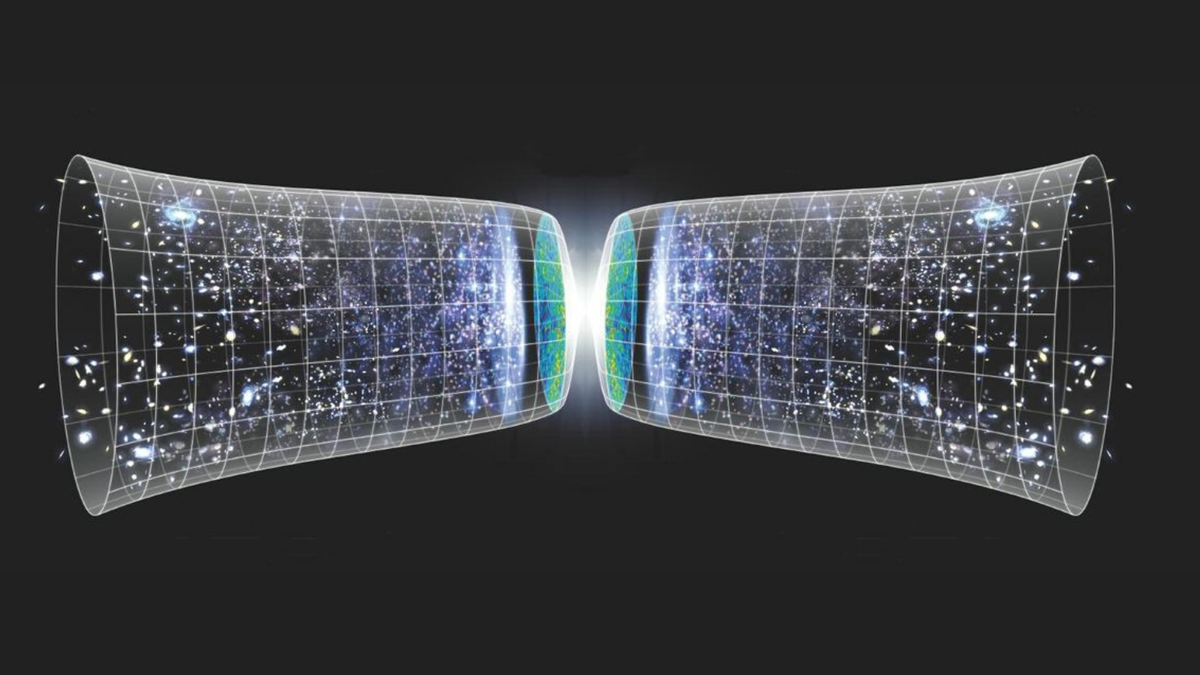
Instead of a unique Big Bang, the cosmic bounce model3 proposes that the universe oscillates endlessly between phases of expansion and contraction. In this scenario, the universe was once much larger, then gradually contracted—but never all the way to zero. At a critical moment, when density reaches extreme values, quantum gravitational effects create a repulsive force that reverses the collapse: the universe “bounces,” like an extremely compressed ball. It then begins a new phase of expansion. This cycle repeats endlessly, without beginning or end.
Theoretical versions:
- Loop quantum gravity: Spacetime is made up of tiny discrete quantum loops. When density reaches a critical threshold, these quantum effects create a repulsive force that halts the collapse and forces the bounce. Advantage: no singularity.
- Ekpyrotic models (string theory): The universe is a membrane (“brane”) that periodically collides with another parallel brane. Each collision generates a local “Big Bang,” followed by expansion and then contraction until the next collision.
-> Planck threshold: All these models set a minimum volume: the Planck volume (~4 × 10⁻¹⁰⁵ m³), at which classical laws cease to hold.
Observational status:
- To date, no decisive observational signature confirms the existence of previous cycles. Researchers hope to find clues in the CMB (geometric patterns, primordial gravitational waves), but cyclic models make predictions very similar to standard inflationary models, making them difficult to distinguish with current data.
- As one cosmologist put it: “There is no empirical evidence for bouncing cosmologies. But there is also no evidence for the initial singularity.” Both scenarios remain observationally compatible with our data.
3. “Eternal” or “emergent” quantum models #
General principle: In these scenarios, the universe does not “come into being” at a well-defined instant zero. Instead, it exists prior to the Big Bang in the form of a quantum state—a quantum vacuum, a quasi-stationary phase, or a mathematical configuration described as “Euclidean.” The expansion we observe is therefore not a creation ex nihilo, but a phase transition: the passage from a purely mathematical quantum reality to a classical expanding universe. In short, the Big Bang is not the absolute event marking the appearance of the universe, but rather a radical change in its physical properties.
What quantum physics means by “vacuum”: A crucial point for understanding these models is that the “vacuum” in physics is absolutely not philosophical nothingness. It is a state of minimum energy, certainly, but one permanently traversed by quantum fluctuations. These fluctuations allow the brief creation and annihilation of particle-antiparticle pairs, a phenomenon well established in the laboratory (Casimir effect, quantum electrodynamics). The quantum vacuum is therefore a rich physical reality, teeming with activity at the subatomic scale. These models never invoke creation from absolute nothingness, but rather the emergence of an observable classical reality from a preexisting quantum reality.
Theoretical versions: There are three main theoretical versions:
The “no-boundary” proposal (Hartle–Hawking): This model assumes that there is no initial “edge” or temporal boundary. Classical time is not fundamental, but gradually emerges from a purely quantum mathematical description (called “imaginary” or “Euclidean” time). One might picture the surface of a globe: it has no “initial” pole—every point is equivalent. In the same way, there would be no instant zero of creation. The wave function of the universe describes all possible configurations, and the singularity of the classical Big Bang is naturally avoided.
Quantum tunneling (Vilenkin): Here, the universe undergoes tunneling—a purely quantum phenomenon in which a particle crosses an energy barrier even though classical physics would forbid it. The universe would pass from an initial quantum state (a “metastable” vacuum) to a classical expanding state through this tunneling mechanism. Unlike the abrupt transition of the classical Big Bang, this is a gradual transition governed by quantum probabilities. Again, there is no creation ex nihilo, but a transition from a preexisting state.
Emergent universe: This scenario proposes that the universe remains for a very long time—potentially eternally—in a quasi-stationary quantum state. There is no true instant t = 0. Then, following certain perturbations or quantum instabilities, it gradually enters the classical phase of expansion that we observe today. The advantage: the universe does not arise from nothing, but slowly emerges from a prior state.
Observational status and challenges:
Unfortunately, these models remain highly speculative.
Three main reasons:
Few testable predictions: These three approaches produce predictions that largely overlap with those of the standard ΛCDM model. In other words, current observations (CMB, large-scale structure) do not allow us to distinguish them decisively.
Different mathematical formalisms: Each model rests on distinct mathematics (Wheeler-DeWitt for no-boundary, tunneling equations for Vilenkin, etc.), and it is difficult to compare their predictions directly.
The problem of interpretation: These models raise deep philosophical questions: how should “nothing” be defined? How does a quantum transition generate classical time? These questions remain open.
Conclusion: To date, no observation has conclusively decided between these scenarios and the classical Big Bang. Until new observational signatures—perhaps in CMB polarization, the distribution of primordial gravitational waves, or other exotic phenomena—are detected, these models remain fascinating but unconfirmed theoretical possibilities.
4. The multiverse #
General principle:
The multiverse hypothesis proposes that our observable universe is only a particular region within a much larger ensemble of universes. In this framework, the Big Bang would not correspond to an absolute beginning, but to a local event—the birth of our universe among potentially an infinity of others. Depending on the version, these universes may coexist without direct interaction, possess different physical laws, or emerge continuously in a process with no global beginning.Theoretical versions:
- Eternal inflation: In some inflationary models, exponential expansion never completely stops. “Bubble universes” continuously form within a space undergoing perpetual inflation. Each bubble corresponds to a universe with its own physical constants—our universe being one of these bubbles.
- String theory landscape: String theory allows for a very large number of possible configurations of the extra dimensions (up to ~10⁵⁰⁰ solutions). Each would correspond to a distinct universe with different physical laws.
- Quantum multiverse (Everett): In the “many-worlds” interpretation of quantum mechanics, each quantum event gives rise to a branching of the universe into several coexisting branches, each realizing a different possibility.
Observational status and challenges:
- To date, no direct observation confirms the existence of other universes.
- By definition, these universes would be causally disconnected from ours, making their detection extremely difficult, if not impossible.
- Some cosmologists nevertheless hope to identify indirect signatures (for example, traces of collisions between bubble universes in the CMB), but no convincing evidence has been found so far.
- The multiverse also raises important methodological questions: is a theory that posits unobservable entities scientifically testable? This debate remains open.
Conclusion:
The multiverse is currently a natural extension of certain physical theories (inflation, quantum mechanics, string theory), but it remains highly speculative and without direct empirical validation.
Above all, it is essential to note that these models do not really solve the question of the ultimate beginning. Whether it is an inflationary multiverse, a landscape arising from string theory, or a quantum multiverse, one still assumes the prior existence of a physical framework—laws, fields, quantum space—within which these universes emerge.
In other words, these approaches shift the question without eliminating it:
- why such an overall framework exists,
- which physical laws make it possible,
- and above all by what mechanism these universes are generated.
Even in scenarios where the universe appears through a quantum transition, this is never a creation from absolute nothingness, but a passage from a preexisting state.
Thus, the multiverse may avoid the idea of a local beginning of our universe, but it does not remove the question of an ultimate foundation of reality.
Alexander Vilenkin concludes in Many Worlds in One4:
Even an eternal multiverse must have a beginning.
Is an eternal universe physically possible? #
Despite the attempts to avoid the idea of a beginning, several results from modern physics impose serious limits on the hypothesis of an infinite past. These arguments rest on general principles—not on any particular cosmological model—and therefore apply to almost all scenarios: the classical Big Bang, bouncing universes, the multiverse, and many others. Let us examine the most important ones.
1. The Borde-Guth-Vilenkin (BGV) theorem #
The main idea: A simple observed fact leads us to a remarkable conclusion: the universe is expanding. If we trace this expansion backward in time, in reverse, the universe becomes smaller and denser. The natural question then arises: how far back can we go? Infinitely far into the past, or is there a limit?
In 2003, three physicists—Arvind Borde, Alan Guth, and Alexander Vilenkin—proved mathematically that:
Any universe whose average expansion is positive cannot be extended indefinitely into the past.5
In other words: if the universe is expanding, it has an earlier temporal limit. There exists a moment “beyond which” the current laws of physics no longer apply.
Why this is so powerful: This result does not depend on any specific detail—neither on the exact equations of general relativity, nor on the type of matter present, nor on precise initial conditions. It applies to a very broad class of cosmological models, including:
- Inflationary models (rapidly expanding universes)
- Bouncing universes (oscillating between contraction and expansion)
- Even some multiverse models (as long as there is positive average expansion)
The theorem remains valid even if physical laws change radically at very high energies, or if the notion of “time” becomes more subtle. A positive average expansion still imposes a boundary in the past.
Alexander Vilenkin summarizes this conclusion as follows:
All the evidence we have says that the universe had a beginning.
Conclusion of the theorem: It shows that even models designed to avoid a beginning—such as cyclic universes or eternal quantum scenarios—cannot be extended indefinitely into the past6, at least as long as a positive average expansion is observable.
2. The increase of entropy (the second law of thermodynamics) #
The second law of thermodynamics states that the total entropy of the universe increases over time.
In other words, physical systems spontaneously evolve from the more ordered to the more disordered, from the concentrated to the dispersed, from the hot to the cold.
A simple image: the cup of coffee
Imagine a cup of hot coffee in a cold room. Over time, the heat of the coffee diffuses into the air: the coffee cools, and the room warms slightly.
The reverse never happens spontaneously: the heat does not return by itself into the cup in order to warm it again.
-> This irreversibility, this natural tendency toward equilibrium, is entropy.
Why do we speak of “disorder” when everything becomes uniform?
This is only an apparent paradox. When a system becomes uniform (like lukewarm coffee or a gas spread everywhere), it may seem visually more “ordered.”
But physics looks at internal order, that is, the way the particles are arranged.
Entropy measures the number of possible ways of arranging the particles in a system without changing its overall appearance.
The more possible configurations there are, the higher the entropy.
- Hot coffee next to cold air → few ways of arranging the molecules → low entropy.
- Uniform lukewarm coffee → billions of possible combinations → high entropy.
Visually, it is uniform; microscopically, it is maximum chaos.

Another analogy: the Lego tower
Imagine a tower of neatly stacked bricks:
- Ordered: few ways of arranging the bricks → low entropy.
- Scattered: bricks spread everywhere → countless possible arrangements → high entropy.
What matters is not the visual appearance, but the number of possible states.
Application to the universe
If the universe had existed forever, it would long ago have reached its maximum entropy: no more heat, no more available energy, no more life possible.
Yet our universe is still structured, full of energy and motion. This means that it began in an extraordinarily ordered state—one of low entropy.
“The present universe is far from thermal equilibrium: it must therefore have come into being a finite time ago in an extraordinarily ordered state.”
— Roger Penrose, The Road to Reality7
-> Thus, the arrow of time and the progression of entropy clearly indicate that the universe is not eternal into the past, but had a beginning from a highly improbable initial state.
Alternative theories in light of these physical constraints #
The BGV theorem and thermodynamics impose two independent constraints on the idea of an eternal universe.
The question therefore becomes: do alternative models really succeed in getting around these limits?
In other words, can they avoid a beginning:
- either by escaping the conditions of the BGV theorem (i.e. positive average expansion),
- or by remaining compatible with the second law of thermodynamics (the increase of entropy)?
Let us examine this point for each of the alternative theories.
The Big Bounce model #
These cosmological models suggest that the universe passes through an infinite series of cycles of expansion and contraction.
The goal is clear: to avoid the idea of an absolute beginning by replacing the initial singularity with a transition between two phases.
But one question immediately arises: do these models really make it possible to escape the constraints imposed by the BGV theorem and thermodynamics?
The problem posed by the BGV theorem:
- Some bouncing models attempt to evade the BGV theorem by assuming that the universe alternates between phases of expansion and contraction, so that over the long term it would not, on average, be expanding.
- In principle, such a dynamics could avoid the condition of the theorem, which applies to universes with positive average expansion.
- However, maintaining this balance is extremely difficult in realistic physical models.
- Many bounce models include a phase of inflation after the bounce in order to explain the observations (homogeneity, flatness, CMB fluctuations). However, this phase of exponential expansion tends to dominate the overall evolution of the universe and may reintroduce a positive average expansion, making the BGV theorem applicable.
The entropy problem:
- The second law of thermodynamics requires that entropy (overall disorder) increase from one cycle to the next.
- This implies that future cycles would become longer and larger, while past cycles would have been shorter and smaller.
- If one goes back indefinitely into the past, this logic inevitably leads to a first cycle—which contradicts the idea of a past eternity without beginning.
Proposed solutions: several hypotheses attempt to circumvent this objection, though no consensus exists:
- Quantum reset of entropy: some loop quantum gravity models assume that at the bounce, extreme conditions erase or reset entropy.
- Dilution through exponential expansion: the models of Steinhardt and Turok introduce a phase of accelerated expansion that dilutes entropy to the point of making it negligible in the next cycle8.
- Two-sided arrow of time: some physicists propose that the bounce generates two opposite temporal directions, each with its own increasing entropy.
- Conformal cyclic cosmology (Penrose): in this model, the future universe, after trillions of years, would become extremely diluted and composed only of radiation. This “scale-free” state would be mathematically equivalent to the beginning of a new universe, endowed with low initial entropy9.
These scenarios are fascinating, but they remain highly speculative and still rest on no observational confirmation.10
-> The Big Bounce model offers an elegant and stimulating vision of cosmic history, replacing the idea of a unique beginning with a succession of cycles. However, when examined in light of the fundamental physical constraints, the difficulties clearly appear.
- To avoid the BGV theorem, one would have to maintain a very precise balance between expansion and contraction—a balance that is difficult to realize in realistic models.
- And even if this obstacle were overcome, the entropy problem remains: the irreversible accumulation of disorder from one cycle to the next makes an infinite succession without some special initial condition problematic.
Thus, even within the framework of a cyclic universe, the existence of a first state or a special initial condition seems difficult to avoid.
“Eternal” or “emergent” quantum models #
Supporters of “emergent” quantum models acknowledge the difficulties posed by the BGV theorem and thermodynamics. However, they put forward several arguments to limit their scope and propose an alternative to the idea of an absolute beginning.
Regarding the Borde–Guth–Vilenkin theorem:
- The BGV theorem establishes that any expanding phase of the universe whose average rate is positive cannot be extended indefinitely into the past. In other words, it implies that the phase of cosmic expansion is finite in the past.
- Quantum models do not necessarily dispute this point, but instead propose a distinction: the theorem applies to the expanding phase (including inflation), but it does not necessarily apply to a prior quantum state in which the universe would not be expanding and in which the classical notion of spacetime would not be defined.
- Thus, according to these models, the expansion of the universe would indeed have a beginning, but it could emerge from a preexisting quantum state to which the BGV theorem does not directly apply.
Regarding thermodynamics and the entropy problem
- For a universe like ours to appear—with structures, galaxies, and temporal evolution—entropy must increase over time. This is precisely what the second law of thermodynamics states.
- But this implies a crucial condition: entropy must initially be low (ordered).
- Why? If the universe began in a state that was already maximally disordered (high entropy), then no structure could emerge and no significant evolution would be possible.
- In quantum models, this constraint does not disappear:
- The quantum state prior to the transition must already be of low entropy.
- And the transition itself (toward expansion) must preserve this low initial entropy.
Proposed solutions:
- The fundamental quantum state might be intrinsically simple (for example, highly symmetrical), which would correspond to low entropy.
- Gravitational entropy might be naturally low in homogeneous states.
- Our observable universe might be a local fluctuation arising from a larger state (multiverse). -> These proposals seek to make an ordered initial state plausible without resorting to explicit fine-tuning.
These responses make it easier to understand how quantum models try to avoid the classical objections:
- They accept that the expanding phase has a beginning (in the sense of the BGV theorem).
- But they propose that it emerges from a prior quantum state.
However, one difficulty remains: why is this initial state precisely the one that allows low entropy and the emergence of a structured universe?
Quantum models therefore do not eliminate the question of the beginning; they shift its framework by locating it at the moment when the expansion of the universe begins, following a transition from a quantum state. Moreover, they still have to assume a special initial condition—in particular, an entropy low enough to allow the evolution of the universe.
Conclusion #
Cosmological theorems (such as BGV) and the laws of thermodynamics converge on the same idea: the hypothesis of an infinite past for the universe faces serious difficulties.
Alternative models—cosmic bounce, multiverse, or quantum models—offer interesting avenues, but at present they do not clearly allow us to escape these constraints. They tend more to shift the question of origin than to solve it.
In this context, the idea of a beginning of space, time, and matter appears to be a difficult hypothesis to avoid.
The atheist philosopher Antony Flew remarked on this subject (in There Is a God6):
It is now widely accepted that the universe had a beginning. This is something that seems to support the claim that the universe was brought into existence by a creative intelligence. As a philosopher, I find this conclusion deeply troubling. For a long time, it was convenient to assume that the universe had always existed. But the Big Bang theory has changed that. It now seems that the cosmologists are proving what Saint Thomas tried to prove philosophically—that the universe had a beginning.
From that point on, one question remains, inevitably:
if the universe began to exist, what could be the cause of such a beginning?
References #
S. A. Mitton, “The Big Bang versus the Steady State: Gamow, Hoyle and Ryle, rivals in cosmology,” Journal of Physics: Conference Series, Oct. 2024, doi: 10.1088/1742-6596/2877/1/012010. Link ↩︎
Kragh, H. (2012). Quasi-Steady-State and Related Cosmological Models: A Historical Review. arXiv: History and Philosophy of Physics. Link ↩︎
James Riordon (2023). The Universe Began with a Bang, Not a Bounce, New Studies Find. Link ↩︎
Vilenkin, A. (2006). Many Worlds in One: The Search for Other Universes. New York: Hill and Wang. ↩︎
Borde, A., Guth, A. H., & Vilenkin, A. (2003). Inflationary Spacetimes Are Not Past-Complete. Physical Review Letters, 90(15), 151301. Link ↩︎
Carroll, S. (2012). Does the Universe Need God? In M. J. Peterson & R. J. Russell (Eds.), Contemporary Debates in Philosophy of Religion. Blackwell Publishing. ↩︎ ↩︎
Penrose, R. (2010). Cycles of Time: An Extraordinary New View of the Universe. Bodley Head. ↩︎
Dalrymple, G. B. (2001). “The Age of the Earth.” GSA Bulletin ↩︎
Planck Collaboration (2020). “Planck 2018 results. VI. Cosmological parameters.” A&A 641, A6 ↩︎
Was the Big Bang Really a Big Bounce? — Columbia Magazine (2019). Link ↩︎