5. Which Divine Revelation to Follow?
In the previous chapters, we reviewed several considerations that make the following two premises (or axioms) reasonable: everything that begins to exist has a cause (Axiom 1), and the universe began to exist (Axiom 2). From these foundations, it is reasonable to conclude that the universe depends on a reality without beginning, unmoving, uncreated, necessary, and outside time — the first cause of all that exists (Statement 1). This first cause appears as an immaterial, eternal, necessary, intelligent, free, and unique being, which philosophical reasoning allows us to identify as the God of philosophers (Statement 2). From this analysis follow three consequences: God is omniscient, omnipresent, and omnipotent; He is perfect — fully complete in Himself; and He is just, acting according to truth and goodness.
If such a God exists, it is reasonable to think that He has revealed Himself to humanity. Many religions claim to transmit this revelation; but in the face of their diversity, a crucial question arises: Is there a single truth and, if so, which religion or belief comes closest to it?
The idea that only one religion is the exclusive path to God and salvation seems difficult to reconcile with divine justice, because religious affiliation largely depends on birthplace, culture, and circumstance, and conversions remain rare at a global scale. Such exclusivity would imply a fundamental inequality among human beings, which conflicts with the notion of a perfectly just God.
To grasp the impact of claiming a single path to God, consider a few statistics. First, look at the distribution of people by religion, globally and by country. According to the Pew Research Center, Christians made up the largest religious group worldwide in 2020 — nearly a third (29%) of the world’s 7.9 billion people. Muslims were second, with about 2 billion people (26%), followed by the unaffiliated (24%), Hindus (15%), and Buddhists (6%). Followers of traditional religions, Jews, and members of other religions account for smaller shares of the global population. These percentages vary greatly by country: Christian shares are particularly high in Latin America, Southern Europe, and Southern Africa; they represent only ~2% of India’s population but about 81% in Portugal. Islam is dominant in MENA and parts of South and Southeast Asia (Pakistan, Afghanistan, Indonesia). The “least religious” countries include China, Japan, Switzerland, Germany, and France. Buddhism is concentrated in East and Southeast Asia, especially Thailand, Laos, and Japan.
Table: Share of the adult population affiliated with each major religion, by country (2020)
| Country | Christianity | Islam | Hinduism | Buddhism | Unaffiliated | Other |
|---|---|---|---|---|---|---|
| 🌍 World | 28.8% | 25.6% | 15.0% | 6.0% | 24.2% | ~0.4% |
| 🇲🇽 Mexico | ~94% | <1% | <1% | <1% | ~5% | ~1% |
| 🇧🇷 Brazil | ~86% | <1% | <1% | <1% | ~8% | ~5% |
| 🇿🇦 South Africa | ~84% | ~2% | <1% | <1% | ~13% | ~1% |
| 🇵🇹 Portugal | ~81% | ~1% | <1% | <1% | ~13% | ~4% |
| 🇮🇹 Italy | ~80% | ~3% | <1% | <1% | ~12% | ~4% |
| 🇷🇺 Russia | ~73% | ~10% | <1% | <1% | ~15% | ~2% |
| 🇺🇸 United States | ~65% | ~1% | <1% | <1% | ~26% | ~8% |
| 🇩🇪 Germany | ~60% | ~7% | <1% | <1% | ~28% | ~5% |
| 🇨🇭 Switzerland | ~60% | ~5% | <1% | <1% | ~28% | ~6% |
| 🇫🇷 France | ~55% | ~8% | <1% | <1% | ~30% | ~7% |
| 🇮🇩 Indonesia | ~10% | ~87% | <1% | <1% | ~2% | ~1% |
| 🇮🇱 Israel | ~2% | ~18% | <1% | <1% | ~3% | ~77% |
| 🇮🇳 India | ~2% | ~14% | 77% | <1% | ~1% | ~6% |
| 🇯🇵 Japan | ~2% | <1% | <1% | 36% | 58% | ~4% |
| 🇨🇳 China | ~5% | <1% | <1% | ~4%¹ | ~90% | ~1% |
| 🇱🇦 Laos | <1% | <1% | <1% | ~66% | ~32% | ~1% |
| 🇸🇦 Saudi Arabia | <1% | ~97% | <1% | <1% | <1% | ~2% |
| 🇦🇫 Afghanistan | <1% | ~99% | <1% | <1% | <1% | – |
| 🇳🇬 Nigeria | ~46% | ~52% | <1% | <1% | <1% | ~1% |
| 🇹🇭 Thailand | <1% | <1% | <1% | 93% | ~5% | ~1% |
📝 Notes #
- ¹ In China, religious affiliation is difficult to estimate precisely. A large share practice non-institutional or traditional forms (Taoism, Confucianism, ancestor veneration).
- In Israel, the “Other” category is primarily Jewish (~77%).
- Pew Research Center data available at https://www.pewresearch.org/religion/feature/religious-composition-by-country-2010-2020/
Second, a 2025 Pew Research Center study ( https://www.pewresearch.org) reports that about 10% of adults under 55 worldwide have left the religion of their childhood. Most of these become religiously unaffiliated, contributing to a slight global decline in the religious share from 77% (2010) to 76% (2020). Only about 3% switch to a different religion. Retention rates vary markedly across traditions: Hindus show remarkable retention (about 1% departures), closely followed by Muslims. By contrast, the unaffiliated largely remain unaffiliated, though some join a faith.
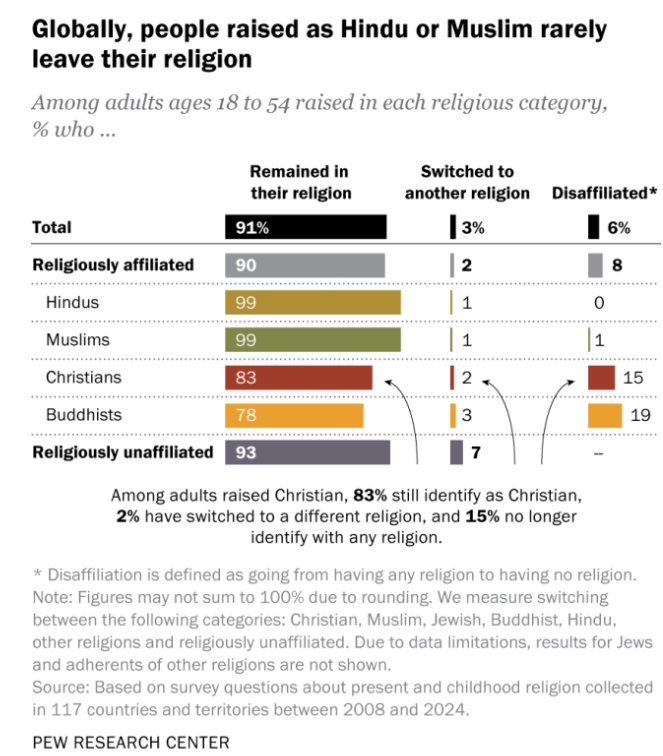
Suppose the following claim were true: “Only one religion is the true path to God and leads to salvation.” Based on the patterns above, this would entail a clear inequality of opportunity among individuals.
For example, if Christianity were the sole path to God, then only about 2% of Indians would have a realistic chance of being saved, given that Hindus show very low conversion rates (~1%). Even though nearly everyone can potentially discover other religions through the internet, television, or daily encounters, that exposure rarely triggers a change of belief. Social and family pressures, political climate, and — quite simply — the intuitive assumption that if any religion is true, it is probably the one we were born into and know best all play a role.
Thus, if God offered only a single exclusive path to salvation, it would amount to granting major spiritual privileges by birth — apparently incompatible with equitable divine justice.
Since God is just, each human being should have a real chance to access truth and salvation. Many theologians and religious thinkers address this through religious pluralism and inclusivism:
- Religious pluralism: All major religions are valid expressions of spiritual search and can lead to the divine. Each tradition, with its cultural and historical particularities, offers a path toward God or salvation. If God is just, then multiple religious paths would be valid in their own ways.
- Inclusivism: One religion may be understood as true (e.g., Christianity from a Christian perspective), yet God, in His mercy, extends salvation to those who do not know that religion, according to their sincerity and good actions. This approach combines a unique truth-claim with a divine justice that reaches all, including those without access to that particular truth.
Personally, I lean toward pluralism. I find it likely that God revealed Himself to humanity in different ways, across cultures and throughout history. Each religion may thus hold part of the truth from a certain perspective. We will look at some indications in favor of this view in the next chapter.
But which religion should one choose? Which path draws us closer to God? I believe the path to God is profoundly personal and varies from person to person, because we are all different. Some are touched by a simple encounter — like Leslie Strobel, whose faith began after a neighbor invited her to church. Others — like the scientist Rosalind Picard — discover God through an inner search and spiritual reading, after long thinking faith was unnecessary. Others, like Akiane Kramarik, speak of encountering God in mystical experience. And then there are those — Lee Strobel or C. S. Lewis — who undertake a rigorous intellectual journey, weighing facts, texts, and reason, before becoming convinced that God exists. Whether through emotion, experience, doubt, or logic, God seems to shape a path suited to each heart and mind. For belief does not follow a single pattern: it is a meeting, tailored to the person.
Let’s look more closely at each person’s story to illustrate the diversity of paths that lead toward God.
1. Lee Strobel and his wife Leslie
It was first his wife, Leslie, who encountered Christian faith after a neighbor invited her to a church service. Moved by the message and the community’s kindness, she began a sincere journey of faith marked by deep inner change. This worried Lee, then an investigative journalist at the Chicago Tribune and a convinced atheist. Fearing that this new faith would threaten their relationship, he decided to conduct a rigorous investigation — not to seek the truth, but to prove to his wife that she was wrong to believe.
For two years, Lee interviewed historians, theologians, medical experts, and New Testament scholars. He examined the case for and against the resurrection, the historicity of the Gospels, and the reliability of eyewitness testimony. To his surprise, the evidence he uncovered challenged his skepticism. His careful, honest inquiry led him to faith.
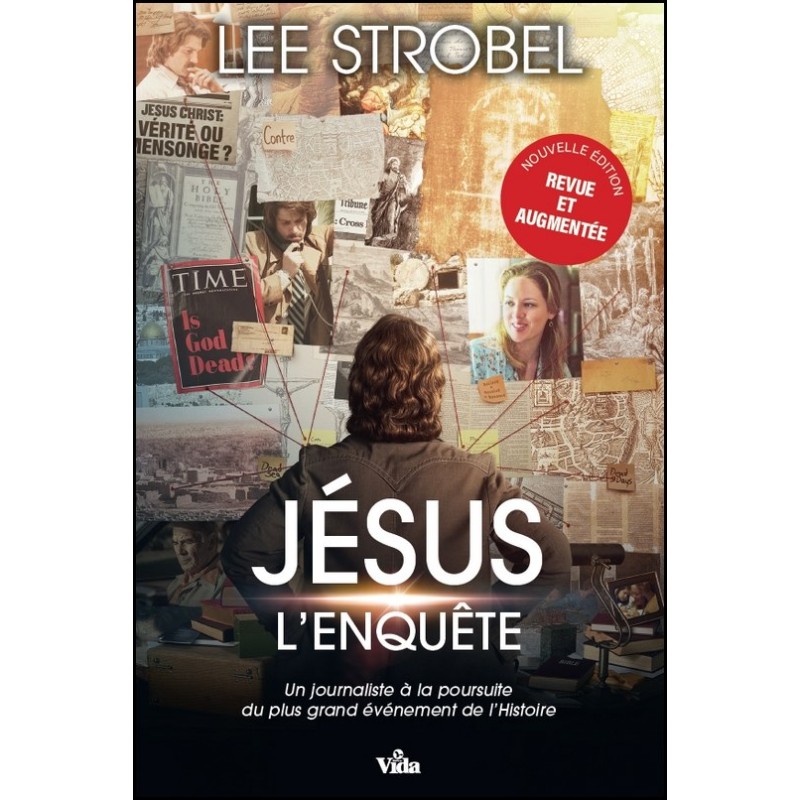
He tells this story in The Case for Christ, a bestseller later adapted for film.
I highly recommend the book — it reads like a detective novel. I will draw on several of its themes in the sections on Christianity, notably arguments concerning the credibility of the disciples’ testimony, the death of Jesus, and his resurrection.
📖 Book: Strobel, L. (2016). The Case for Christ: A Journalist’s Personal Investigation of the Evidence for Jesus (rev. ed.). Grand Rapids, MI: Zondervan.
Lee Strobel – The Case for Christ: A Journey of Faith and Evidence: https://www.youtube.com/shorts/CGMX9GQs6fY
2. Rosalind Picard: from atheism to Christian faith
Rosalind Picard, a renowned MIT researcher and pioneer of affective computing, long considered herself an atheist. A brilliant, science-minded child, she thought religious people were ignorant. She recalls:
I used to think religious people were ignorant. Then I took the risk of believing in God.
Her perspective began to shift when a physician couple she admired invited her to church. Surprised that such intelligent people were believers, she initially declined, then agreed to read the Bible out of intellectual curiosity.

She began with Proverbs, then read the entire Bible in a modern translation. To her surprise, she found deep wisdom and felt an inner voice that moved her:
I never heard a voice, but I had this strange sense of being addressed. It was unsettling, yet strangely compelling.
She then reread the Bible with the intent to refute it, while also exploring other religions. Over time, through reading and reflection, she came to believe that God is not an abstract concept but a living, loving reality:
I realized God wasn’t a concept. He was alive. He loved me.
Today, she says her faith does not contradict scientific rigor but provides a moral foundation and a deeper vision of human dignity.
3. Akiane Kramarik
Akiane was born July 9, 1994, in Mount Morris, Illinois. Her mother, Forelli, of Lithuanian origin, was an atheist; her father, Mark, a lapsed Catholic from Chicago, had left religious practice. The family lived in poverty in a cabin near a cornfield — no TV or radio, very little income.
At age four, Akiane began speaking of visions of God and heaven. In a home where God was not discussed, she nonetheless spoke about Jesus and God’s love.
Very early, Akiane drew on walls and floors, then on sketchbooks. By six, she sensed that painting was her path, rising at 4 a.m. to draw, correct mistakes, and improve.
At eight, Akiane felt called to paint Jesus’ face as she had seen Him in her visions. After months of searching, she spent a day praying that God would send the right person. The next day, someone brought a carpenter to their door who looked exactly like the Jesus in her visions. In about 40 hours of work and 20 hours of modeling, she completed Prince of Peace. She explains that the illuminated side of the face symbolizes truth; the other, suffering — but the light shining in the dark eye means Jesus is always with us.
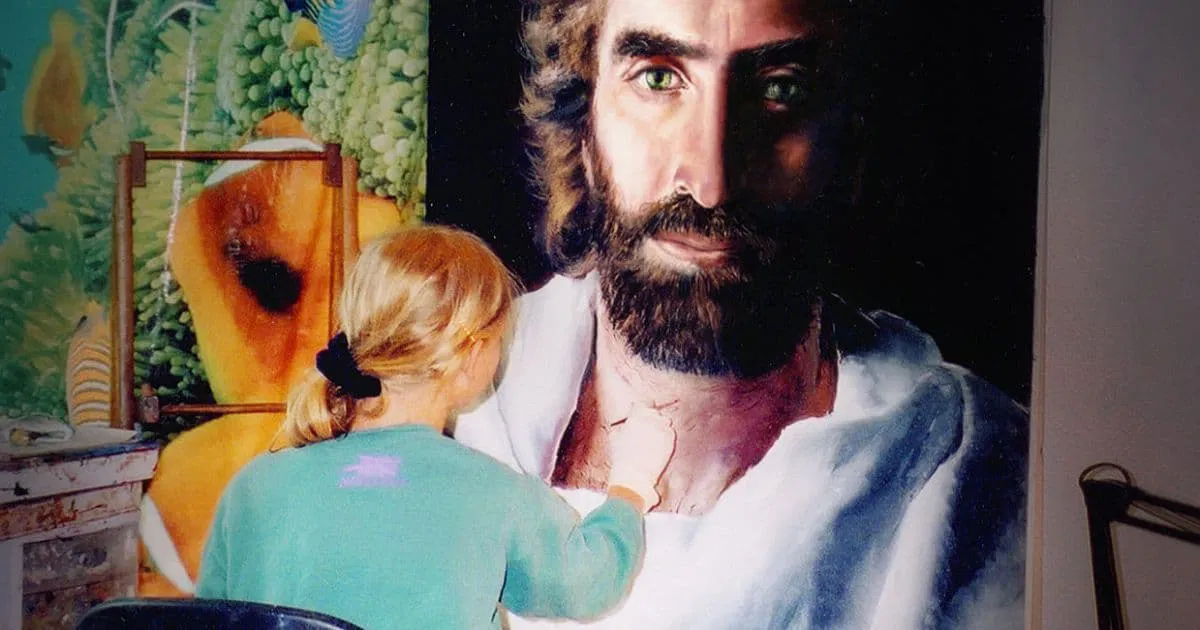
The original Prince of Peace, entrusted to an art agent, was stolen and held for ransom. After a legal battle, it was illicitly sold and hidden under a staircase. The owner later died; the family kept the painting in storage, refusing to exhibit or sell it. Only a high-quality reproduction allowed the image to spread, making it one of the artist’s best-known works.
Sixteen years later, the original resurfaced: it was purchased for $850,000 by a major collector, and Akiane was finally able to see it again — a deeply emotional moment.
The painting’s spiritual resonance grew when Colton Burpo (of Heaven Is for Real fame) identified it as the most faithful likeness of Jesus he had seen in his near-death experience.
Now 30, Akiane remains deeply marked by her personal relationship with Jesus:
Since no one told me who God was, I found Him myself… I don’t belong to any denomination; I belong to God.
She dedicates her art to helping others, supports charities, and dreams of founding an art academy — seeing her talent as a way to draw people closer to God. Through her faith, her entire family (parents and siblings) also found their way to Jesus.
- FaithPot.com
- 📘 Book: Akiane: Her Life, Her Art, Her Poetry
- 🖼️ Official site
- 🎥 Video on Akiane, Interview, Akiane & Colton
4. C. S. Lewis
An Oxford professor and brilliant intellect, C. S. Lewis was first a skeptical atheist. Over time — through reflection, conversations with believing friends like J. R. R. Tolkien, and his search for meaning — he concluded that Christianity best explains the human longing for justice, beauty, and truth. His conversion became a turning point; he devoted much of his work thereafter to clarifying and defending the Christian faith with depth and clarity.
These accounts are personal narratives, but they help us understand the inner experiences that lead some people to faith.
⚠️ Note: I found mainly testimonies of atheists becoming Christian. That’s not a deliberate selection bias on my part. It may reflect the Christian culture of giving testimonies, the language of my searches, or my search history. Please feel free to share accounts of people converting to other religions.
God knows each of us intimately and traces a path tailored to each person. Whether through logic, art, spiritual experience, reading the Bible or the Qur’an, or meaningful encounters, every story is a unique testimony to divine love seeking to meet the human being where they are.
In the next chapters, I’ll describe the path I followed. After reading many testimonies, I turned to what we can learn about what happens after death — especially near-death experiences. In parallel, I read the Bible and many works of Christian theology. I focused on Christianity because it is my cultural background and felt like a natural starting point.